

All the Admiral's Men
Before the Spurs became a dynasty and Tim Duncan rose to stardom, the idea of David Robinson shaped a city, a team, and the birth of a championship culture.

There is something almost romantic about the San Antonio Spurs’ first championship in 1999. It could be described as an astronomical alignment of planets, a specific moment when physical talent converges with uncanny morality and integrity, reaching one of the highest and most coveted points in the history of the NBA.
Rewatching the old footage – mind you, almost 27 years have passed – it all seems destined to be. From the very first moment, it was clear that team was special, and it was only a matter of time before they achieved the ultimate dream.
Gregg Popovich perhaps knew it, or maybe he was simply hoping that his plans would come to fruition. That is why, amidst the chaotic and overwhelming explosion of joy from the victorious Spurs on the court of the Madison Square Garden after Game 5 of the 1999 NBA Finals, Popovich took a moment for himself to feel the energy around the Garden and observe his guys. His guys. Most of them were already in their thirties, yet they genuinely looked like kids, jumping and roaring, incredulous at what had just happened, relief and pure excitement written across their faces as they became champions.
In 1999, before the NBA Finals, the Spurs weren’t the morally precise, systematic San Antonio Spurs we know today. Gregg Popovich was only in his third season as general manager when he fired coach Bob Hill and took over, back when the Spurs had the third-worst record and won Tim Duncan in the lottery. Popovich perhaps had only a general vision of the ideal team, a special quality shared by many great coaches. For instance, Phil Jackson had no intention of becoming a proper coach during his years as a player, but his integrity and deep understanding of the game made him the perfect choice. What might now seem like the result of a single night was actually the product of a long, gradual process spanning four years of rebuilding. Popovich set the stage for a real turnaround. In a certain sense, after all, he was different. He was, simply put, exactly what San Antonio needed. That’s why, in an article written by Mark Heisler for the Los Angeles Times – “Pop Go the Spurs” – published on June 25, 1999, Gregg Popovich was described with the following words: “Popovich, however, inspires fierce loyalty from people who have broken through, some of whom are in the press, who prize his honesty and humility. He’s almost too real.”
Therefore, looking at his guys, he is, at least in my imagination, a paternal figure. In San Antonio, he created a community which goes beyond the simple concept of playing and scoring, as he also educated a team, shaping them into men first and champions second. This paternal stance, in fact, is evident whenever he speaks about his players, and in a specific moment after the 1999 NBA Finals, he confessed, “The real satisfaction for me is watching David [Robinson] and Sean [Elliott] and Avery [Johnson] smile and enjoy it after being together for so many years, and things finally work out for them.”
What remains of the 1999 season, in retrospect, is a lot to take in. After all, Gregg Popovich was only in his second (full) season as the team’s head coach; Tim Duncan, the future face of the franchise and one of the greatest, yet most underrated and private, players in the league, was an emerging superstar whose favorite pastime included avoiding the press and playing video games in his room; the Spurs’ culture had no foundation yet, and the team’s triumphs before the modern era were tightly linked to the days of the American Basketball Association (ABA) and the George Gervin era in the late 1970s and early 1980s, especially following the inclusion in the NBA in 1976. In this context, although the team had its fair share of positive results and successes, the greatest achievements always seemed just out of reach.
And it remained that way until David Robinson’s arrival.
The Admiral
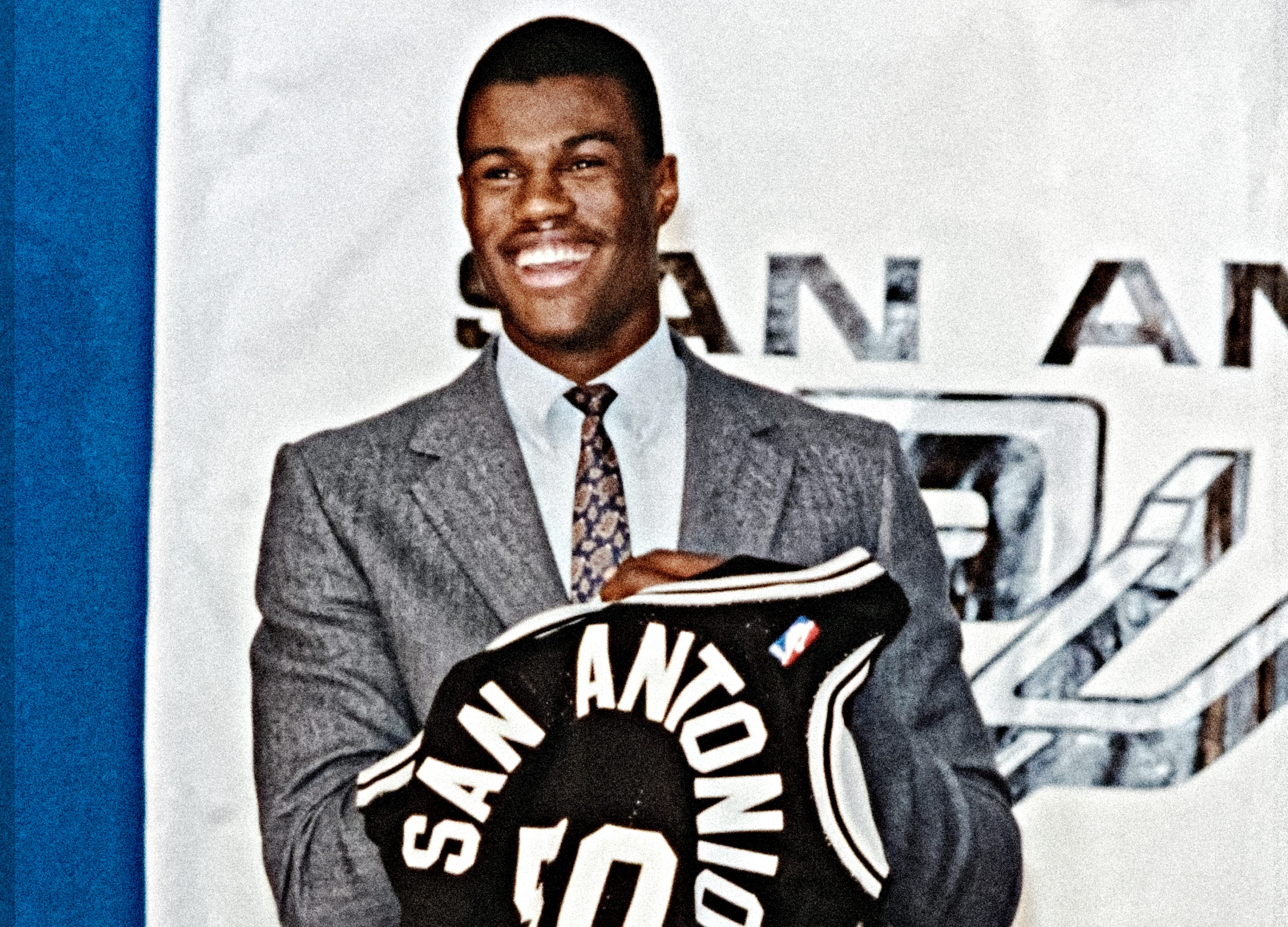
“Hopefully, he will lead us to the Promised Land,” said Angelo Drossos, the majority owner of the San Antonio Spurs in 1987, speaking about David Robinson. Robinson, the 7-foot-1 Naval ensign who had been named college basketball’s Player of the Year, was a future Hall of Famer fulfilling his two-year obligation to the U.S. Navy. When he arrived in San Antonio in 1989, he was seen as a highly anticipated savior for the Spurs, finally making his debut after completing his two-year naval service. By the time of the 1987 NBA draft, for San Antonio it was a real question of courtship: Robinson was the only viable option after years of disappointments, and the idea of him becoming a free agent after his naval service or signing with another team was unthinkable. The San Antonio community and the Spurs’ owners, including Angelo Drossos, were ready to fight for the star player. And it all began with the first impression of San Antonio. As Gordon Edes wryly wrote in his article for the Los Angeles Times, in fact, “The weekend before, John Paul II had toured the town. This visit, Angelo Drossos confided, was bigger than the Pope’s.”
While David Robinson was still uncertain about his future team and visiting San Antonio – a city that celebrated him with banners and elaborate tours – Gregg Popovich was serving as head coach Larry Brown’s assistant, until a brief stint in 1992 with the Golden State Warriors. The general manager of the San Antonio Spurs at the time was Bob Bass, who had spent the previous 20 years (since 1974) with the franchise and witnessed firsthand the rise of the George Gervin era and the ABA-NBA merger. Bass was keenly aware that San Antonio’s lack of mainstream appeal could complicate the courtship of David Robinson. As Robinson’s agent Lee Fentress – who had also briefly represented the late Len Bias – once said, “There’s the city of San Antonio, and the franchise itself. Will they be contenders and if so, when?”
The main point, therefore, was Robinson’s final choice. His charisma, integrity, talent, and intelligence played a major role in the interest people had in him. Bob Bass himself stated that Robinson was a highly marketable player, comparable to legends like Julius Erving and Kareem Abdul-Jabbar, athletes who could attract attention even while playing in the middle of a desert. However, San Antonio in 1987 was no Los Angeles or New York. In retrospect, the city was betting its future on Robinson’s success. For instance, a new stadium was needed downtown, and the reputation of a big-league city would help make that possible. Just the idea of David Robinson was already beginning to change things.
The day David Robinson visited San Antonio, Dan Cook, the dean of San Antonio sportswriters, wrote an open letter to Robinson that was later published in the Express-News. Cook, in what seems almost a prophetic moment, wrote, “If you hang out here long enough to wear out a pair of shoes, you’ll probably never leave forever.” Ultimately, Robinson chose the San Antonio Spurs, signing a deal of $26 million over 10 years, including the two years he spent at the Naval Academy. While some noted that his salary could have increased more during those two years, Robinson’s loyalty to the Spurs from the very beginning is admirable.
Therefore, drafted in 1987, he officially debuted in the 1989-1990 season, retaining his rookie status, an aspect that also made him eligible for the 1990 NBA Rookie of the Year award, which he eventually won. San Antonio had gone to great lengths to secure the perfect man for a new era of the franchise, and actually did what was right by courting him and making him feel valued and appreciated. In those years, however, the success of the Spurs’ plans was far from guaranteed. As Gary Cartwright wrote in 1987:
The Spurs are a young team in a city with big plans, but that’s all they have to sell. If Robinson is looking for the sort of contract the New York Knicks gave Patrick Ewing, the league’s top draft pick in 1985 – a ten-year package totaling $30 million – he’ll have to look to one of the richer franchises.
David Robinson, after all, was a player desired by the league’s biggest teams. Some believed in those years that he could become the heir to Magic Johnson in Los Angeles, while others imagined him alongside Patrick Ewing in New York. Either way, compared to the San Antonio Spurs of the late 1980s, those teams were bigger, more legendary, characterized by impressive histories and even more impressive players. Spurs coach Bob Weiss met Robinson during his 1987 visit to San Antonio and, in a quiet moment alone with him inside a limousine, he openly asked about his intentions. Robinson, always polite and composed, listened carefully and considered Weiss’ words, before responding: “Half the little kids in the country want to grow up playing for the Lakers, but I never did.” He also acknowledged his own doubts with the following words:
You look at the Spurs on paper and that’s a lot of trouble. Losing seasons, the attitude is down, and you think you don’t want to get into that. And then you look at the Lakers and you see it’s wonderful, they’re in the finals every year. It would be a great situation to win 60 games a year. But behind the scenes, you never know what’s going on. You really don’t.
Moreover, he reflected on the situation Patrick Ewing faced when he joined the New York Knicks with the goal of winning a championship. The pressure soon became a burden, particularly for the talented young player, who was subjected to criticism and harsh judgment. Although Robinson was tempted by the prospect of being the protagonist of a team rebuild and the central figure of a franchise, it was a heavy responsibility for a man in his twenties. In this context, he told Weiss, “I don’t want to be put in a situation like that. I have confidence in my ability. I believe I can become a very very good player. But I don’t want people to expect I can come down here and move mountains. It’s not that easy.”
Still, David Robinson’s decision, while unusual for a highly marketable and respected player who could have had bigger opportunities, was guided by higher principles he had always valued. The San Antonio Spurs, at least in those early moments of the rebuilding process, never took that for granted.
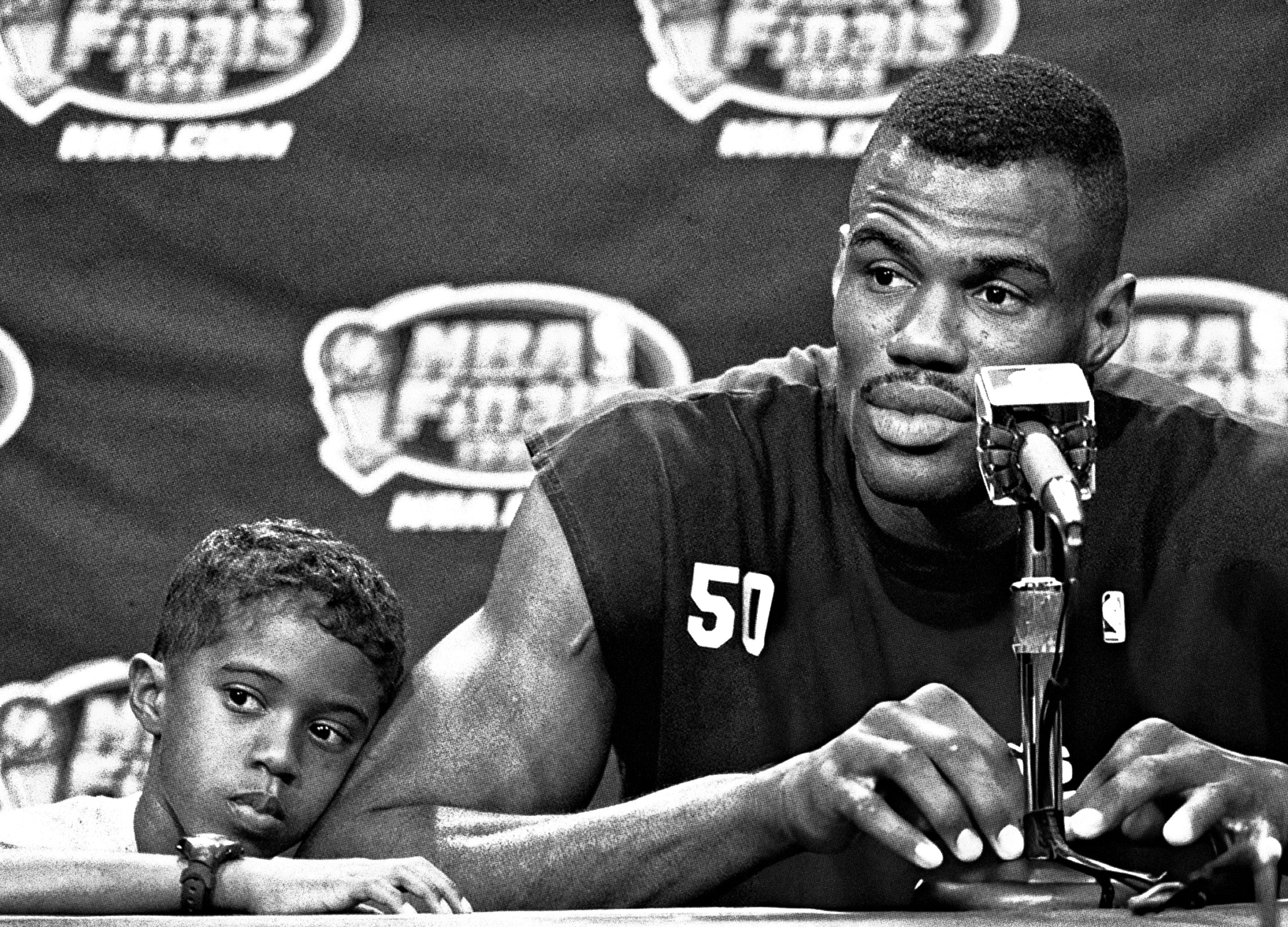
To recount the detailed story of what happened between David Robinson’s debut and the 1999 NBA Championship would require an entire book. The accounts are numerous, each contributing to the reputation and legacy of Robinson’s remarkable career. Although he didn’t immediately achieve the triumph he might have been expected to, thus entering, alongside Patrick Ewing, a sort of purgatory for great players who couldn’t capture a championship, he still amassed a remarkable collection of successes. For instance, his contribution to the 1992 USA Dream Team stands out, as he played alongside the most famous and talented players in the league, cementing his name in NBA history. Moreover, the NBA individual awards – including Most Valuable Player (1995), Scoring Champion (1994), Rebounding Leader (1991), Blocks Leader (1992), Defensive Player of the Year (1992) – underscore the league’s recognition of his talent. Additionally, he was the last player in the history of the NBA to achieve a quadruple-double in 1994, joining an exclusive list that included Nate Thurmond (1974), Alvin Robertson (1986), and Hakeem Olajuwon (1990).
But more than the size of his reputation or the weight of his image, it was the person David Robinson was that stood out. If you watch the end of Game 5 of the 1999 NBA Finals—as I’ve often done, out of pure fascination—and look closely, you might see exactly what Popovich saw that day. There he is. David Robinson’s smile is contagious, and he’s holding his son in his arms – one of the first things he did after the win – as if his life depended on that small figure. Around him, people talk and celebrate, some calling to him through the crowd, but nobody really matters in the midst of the jubilation. Later, holding the trophy high above his head, his eyes close, and relief floods his face. It’s a brief but deeply poignant moment. He nods, breathes, and rejoins the celebration. Overall, in these moments, his teammates can’t help but hug him. They weave through the mass of people surrounding the Madison Square Garden court, fighting the wide grins in their faces, just to reach his towering figure. And when they do, they seem to transform back into kids, their excitement uncontainable.
The tension of the last game is soon forgotten, just like the strange environment so dissimilar to the Alamodome they’re so accustomed to. Avery Johnson finds him, immediately clinging to him in a sudden burst of affection and celebration. Tim Duncan, the other half of this winning duo, exhausted and emotional, holds him firmly. Later, while accepting the Finals MVP trophy, Duncan reflected on the moment: “I think it’s going to be very hard for me to explain to you guys how great this feels and how important it was not only to win it, but to win it for people that have worked so hard like Dave and AJ and Sean. People that have been right there, right on the brink of winning it and haven’t been able to get over that edge.”
Robinson had endured a decade of criticism, much like Patrick Ewing, who was coincidentally present that night as an injured player who couldn’t contribute. But now, unlike Ewing, he had the chance to celebrate with teammates, friends, and family, marking one of his greatest achievements. Mario Elie admitted, “I was so proud of him. I said, ‘Dave, you shut everybody up. They can leave you alone now.’” Sean Elliott, one of the few survivors of the rebuilt team who shared nine seasons with Robinson, similarly couldn’t help but embrace everyone around him. Meanwhile, Popovich watched quietly from a corner of the court, taking it all in.
It’s remarkable how, even in a formative version of the team, the familiarity and moral principles were already taking shape from those very first seasons together. It is a condition that, in my opinion, goes beyond the mere concept of individual star player. Although David Robinson brought the initial spark of possibility for triumph, no single player could achieve it alone. This is a truth that all legendary players eventually have to accept. Kareem Abdul-Jabbar understood it, as did Michael Jordan, who began actively winning championships only after he unironically started passing the ball. A star player is important for providing leadership and serving as the face of a team, but what truly matters happens once the players are on the court. During his years with the Spurs, David Robinson grasped the significance of camaraderie and the values worth sharing with teammates and spectators alike. He could have been the star, just as Tim Duncan would be later, but the question remained the same: at what cost?
I like to think of those first moments as NBA Champions in a way similar to how some say that, in frightening or shocking moments, your life flashes before your eyes. I like to imagine that David Robinson, holding his son and smiling at familiar faces, saw his own career pass before him in an instant. In hindsight, he had every reason to celebrate. Although the New York Knicks were widely seen as underdogs, the imbalance was sometimes only superficial. The Knicks boasted a physical and talented roster, emphasizing offense in contrast to the Spurs’ formidable defense, but their players were excellent. The two teams were highly different, and the stakes were immense for both sides. Robinson, especially during the 1999 playoffs, never took that for granted. Before Game 5, deep in the bowels of Madison Square Garden, Robinson and Avery Johnson were to give their final pregame speech. Typically, they alternated, but sensing the significance of the moment, Johnson stepped aside to give Robinson the floor. With his voice rising and bearing the stance of a true military man, a leader before his army, Robinson said, “It’s like David and Goliath. But we’re not Goliath. We’re still David. Now we have to go cut the lion’s head off.”
Eventually, after years of being the team’s superstar and primary offensive force, David Robinson’s approach to the game evolved. He adopted a more collaborative style—one that embraced the contributions of his teammates and a rising star, Tim Duncan. During the 1996–1997 season, Robinson missed multiple games due to a back injury and a broken foot, making the prospect of winning a title seem distant if the team relied solely on his offensive production. With the arrival of Tim Duncan, however, things changed: Recognizing the talent and potential of the young player, Robinson chose to act selflessly, reshaping the team’s hierarchy. Reflecting on this new approach in 2003, he said, “Everybody talks about me sacrificing my game. I didn’t really think I was sacrificing my game. I just thought, if we want to win, this is the way we need to play.”
Although Duncan would later become the embodiment of selflessness in both the league and the franchise, the first true example came from his teammate and mentor, David Robinson.
And that intuition proved to be absolutely correct.
The Admiral’s Men
During Game 2 of the 1999 NBA Finals, held at Madison Square Garden in New York City, broadcasters noted the contrasting conditions of the rival teams. In a shortened season characterized by the infamous lockout and the absence of the traditional Chicago Bulls roster led by Michael Jordan, it seemed almost fated that two teams led by NBA veterans would face off in such an unusual year.
This was the first time former Bulls head coach Phil Jackson referred to a season as an “asterisk year,” a label that eventually sparked controversy among those involved. For context, the 2020 season, shaped by the COVID-19 pandemic, could also be described as an “asterisk season.” Within this framework, the conditions for winning were unusual, pragmatic, and highly peculiar compared to a standard NBA season. Yet, despite the anomalies, these teams fully deserved to be there.
Therefore, the broadcasters highlighted the exceptional and entertaining Cinderella run of the New York Knicks. At the same time, they acknowledged the San Antonio Spurs, referring to them as a team of “vagabonds.” While the term might seem harsh, considering the context and circumstances, it was a defensible point of view. David Robinson, as previously mentioned, was the heart and soul of the team. Drafted in 1987 and debuting in the 1989–1990 season, he remained loyal to the organization, retiring as a Spur in 2003 after winning another title and accumulating numerous other accomplishments. Apart from him, the only other first overall draft pick in franchise history was Tim Duncan in 1997 – and later, in 2023, Victor Wembanyama would join that list. These were the franchise’s “pure” players: loyal, dedicated, and uncontaminated by the rest of the league. Robinson and Duncan, beyond forming the intense and effective duo the NBA came to know, quickly became the faces of the franchise, particularly because their values perfectly aligned with the team’s ethos.
On the other hand, the rest of the roster was – just as the broadcasters remarked in 1999 – a team of “vagabonds.”
Sean Elliott was drafted in 1989 and spent 11 seasons with the Spurs, with the exception of one year spent with the Detroit Pistons (1993-1994). Over time, he became a key component of the 1999 championship team. Beyond being versatile and intelligent, Elliott excelled at combining offensive prowess with solid defense. In the 1990s, for example, he served as a scoring option alongside David Robinson. When Tim Duncan joined the roster, Gregg Popovich initiated a major team rebuild upon becoming head coach, retaining only a few top players like Robinson and Elliott. Will Perdue, who played for San Antonio from 1995 to 1999 and had been part of the Chicago Bulls’ first three-peat (1991-1993), reflected on the rebuild: “We were in a position that year, guys were dropping like flies. And the one thing he [Popovich] tried to instill in us, he started with a defensive philosophy.” Popovich was clear about this new mentality from the start, even though it was only the initial phase of what would later be recognized as the pragmatic “Spurs Way.” Within this context, he explained, “We tried to do it by demanding it, giving minutes according to defense, doing whatever we had to do to make sure people understood they could not be in the program if they didn’t buy that philosophy. And now we’ve got a group of guys that buy it, big time. That’s what sustains us.”
In this new approach to the game, Sean Elliott became a crucial force. His “Memorial Day Miracle” in Game 2 of the playoffs against the Portland Trail Blazers effectively saved the series for the Spurs. Reflecting on the moment, Elliott said, “I had already made five 3-pointers that game. I told the guys I had one more in me.” The event itself was almost accidental. Popovich had intended to free Robinson and get him the ball, but Elliott improvised on the spot. As Rasheed Wallace of the Trail Blazers closed in with outstretched arms, Elliott launched the ball into the basket, giving the Spurs the lead. Popovich later remarked about the shot, “His whole life is predicated on that shot. It’s like how some people never leave high school.” That moment gave San Antonio newfound confidence in their natural talent, transcending the trauma of past seasons when reaching the Finals had always seemed out of reach. As Jeff McDonald wrote in the San Antonio Express-News on May 25, 2019, in the article titled “The Memorial Day Miracle, 20 years later,” one passage is unquestionably symbolic:
What happened in the 1.1 seconds after that photo was snapped would change Elliott’s life, the future of two basketball-loving communities, and the Spurs’ hard-luck reputation as NBA also-rans. […] Turns out the sound of decades worth of playoff demons exiting a building can make quite a racket.
That moment exorcised years of painful memories and came to symbolize a true revolution for the Spurs.
Yet, incredible as it may seem, Sean Elliott didn’t even have to play that day. This fact remained unknown until after the game, when a blood test revealed his chronic kidney condition. Following the Finals in June 1999, Elliott underwent a kidney transplant in August, returning just in time to receive his championship ring at the start of the next season. Dressed in a suit, he accepted the ring alongside his teammates before a game against the Philadelphia 76ers. Coincidentally, 76ers head coach Larry Brown, who had been Robinson’s and Elliott’s first coach when they were drafted by the Spurs, was present that day.
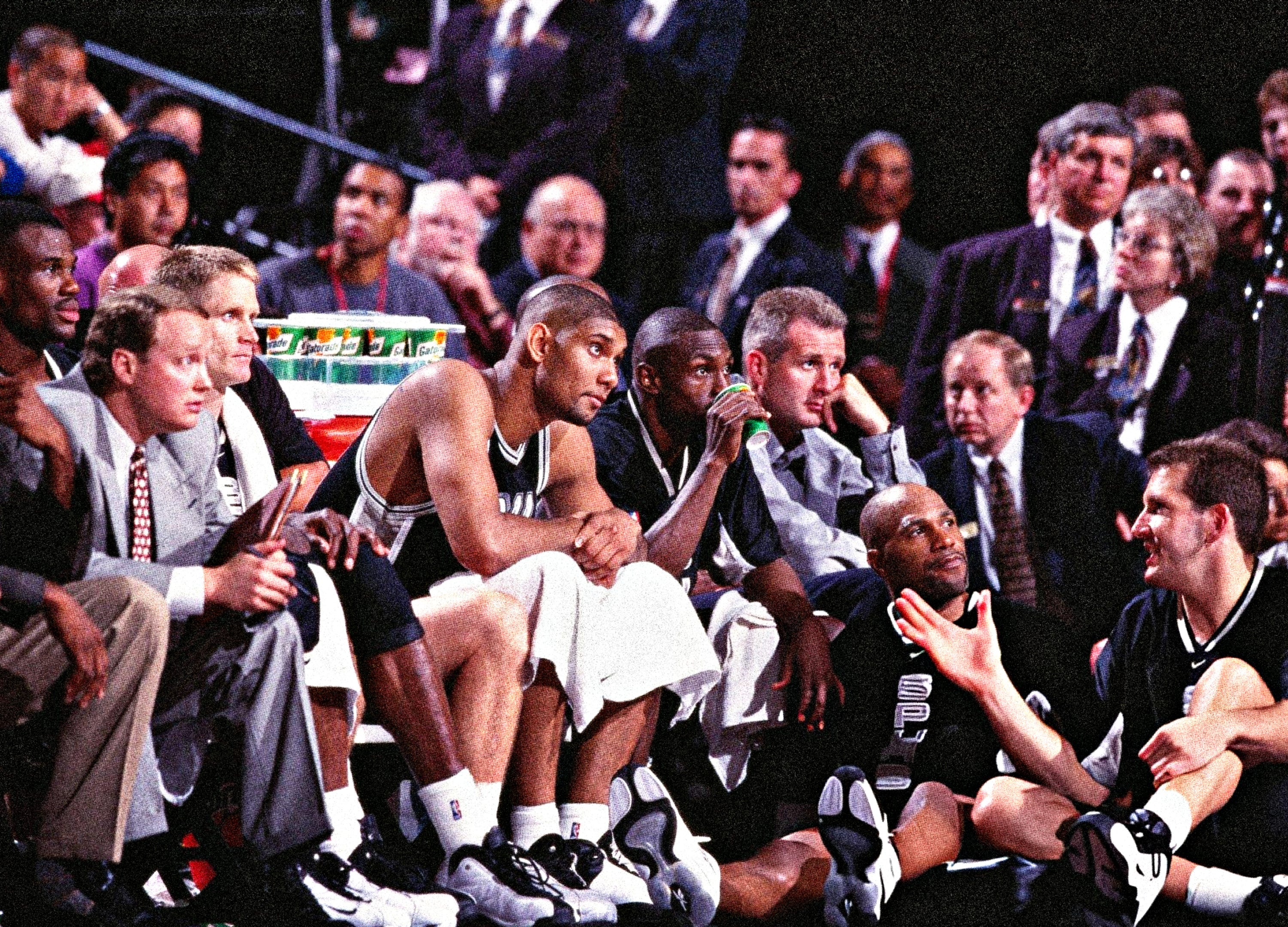
Avery Johnson, meanwhile, was another “vagabond.” He fully understood his role on the team, commenting, “Naturally I’m not the first option. I’m probably the fifth option a lot of nights.” Johnson may not have been one of the franchise’s first choices, but he was essential to the 1999 roster. Known as “The Little General” for his 5-foot-11 stature, he brought far more energy and grit to the court than many of his opponents, coupled with a cerebral approach to the game. Over his career, he played for multiple teams, including three separate stints with the Spurs (1991, 1992-1993, 1994-2001). Antonio Daniels, one of the younger players on the 1999 squad, said, “Avery was not fast. He wasn’t big. He wasn’t all that athletic. He just understood the game and how to use what the Lord blessed him with.”
If the Spurs won Game 5 of the 1999 NBA Finals, it was largely thanks to Johnson’s most important shot in the history of the franchise. Trailing 77–76 with just under a minute remaining, Johnson had the opportunity to show Popovich, his previous teams, and his teammates exactly how valuable he was. Sean Elliott, ironically comparing their contributions, remarked, “My shot was huge. His was gigantic.” With 47 seconds left, Johnson’s jumper gave San Antonio the lead, ultimately helping turn them into champions. As the Express-News reported after Game 5:
And for years, as everyone well knows, the knock on Johnson was that he couldn’t shoot. But there he was, open and squaring up from 18 feet with 47 seconds left, the Spurs trailing by one. Swish.
Then, if we closely observe the names on the list of the 1999 roster, the label “vagabonds” seems quite fitting. For instance, one notable contributor was Mario Elie, a seasoned role player who had already won championships in 1994 and 1995 with the Houston Rockets and was now a veteran at the tail end of his career. With his championship experience, Elie provided crucial support during the team’s period of transformation. Winning the 1999 title, Elliott grabbed the final rebound and tossed it into the air, while Elie threw himself into the group hug with his teammates. Jaren Jackson joined his colleagues, especially since he also played a valuable role during the 1999 championship run. By the end of his career, Jackson had played for 14 teams across the NBA and the CBA, including a brief stint in France, before landing in San Antonio and helping secure the title. Malik Rose, with his toughness and defensive prowess, proved to be another perfect addition to an already growing and talented roster.
Then there was Steve Kerr, whose career already included the Chicago Bulls’ second three-peat (1996-1998). By the time he joined the Spurs, he remained a valuable player, offering insight and reliable veteran performance off the bench. Along with Elie and Will Perdue, Kerr was one of the veterans Popovich added before the season to instill a championship-winning mentality and teach the type of game necessary to succeed. Regardless of whether these veterans played fewer minutes or were starters, their presence commanded respect throughout the team. Reflecting on these additions, Sean Elliott said, “Steve Kerr brought a lot of insight and knowledge. We had known each other since college (at Arizona). Mario brought an edge and a toughness. He and Avery, they were the police. They were the bulldogs. They brought an intensity and an edge to every practice and every game.” Antonio Daniels added, “Mario had won two championships. At that time, Pop hadn’t won any. So Pop would pick those guys’ brains. If Mario came in at halftime and said something, Pop would listen. I think that helped Gregg Popovich become Gregg Popovich.”
However, to guide this team of “vagabonds” and an uncertain head coach, who was risking his position just a few days into the season, there was one constant: David Robinson, The Admiral. Perhaps it was his commanding presence, his authoritative stance, or his winning smile, but everyone trusted David. He possessed talent, a calm and charming demeanor tempered by discipline and ambition, and a drive to prove he was the player everyone believed him to be when he first entered the league. Most importantly, Popovich – Pop – trusted him.
One example of this unwavering relationship came at the beginning of the 1999 season. Although Popovich was both the general manager and head coach of the Spurs, his position was in jeopardy after a disastrous performance against the Utah Jazz in the 1998 Western Conference semifinals, where they lost 4-1. With the team off to a rough start, Popovich’s future was at stake. Therefore, in response, he privately summoned David Robinson and Avery Johnson, his most trusted veterans. According to Johnson, Popovich said, “Boys, we’ve got to win this game in Houston. If we don’t there could potentially be a coaching change.”
Both players were taken aback, yet trusting Popovich’s leadership, they sought a solution. Defense was already a strength, but scoring remained a major issue. In a moment of selflessness, Robinson offered to cede some of his shots to Tim Duncan, the team’s emerging star. Meanwhile, Popovich instructed Johnson to play freely, without seeking bench approval, and to make decisions in the team’s best interest. The meeting remained confidential, but when the team arrived in Houston, Johnson spoke privately to the players, warning them of the risk to Popovich’s job. Antonio Daniels recalls that moment vividly, “We had that meeting on the bus in Houston, and it changed everything.” The tale remains legendary as, after the meeting, the Spurs went on a tear, going undefeated for 17 days and winning 31 of their remaining 36 games. Ultimately, they secured their first NBA title.
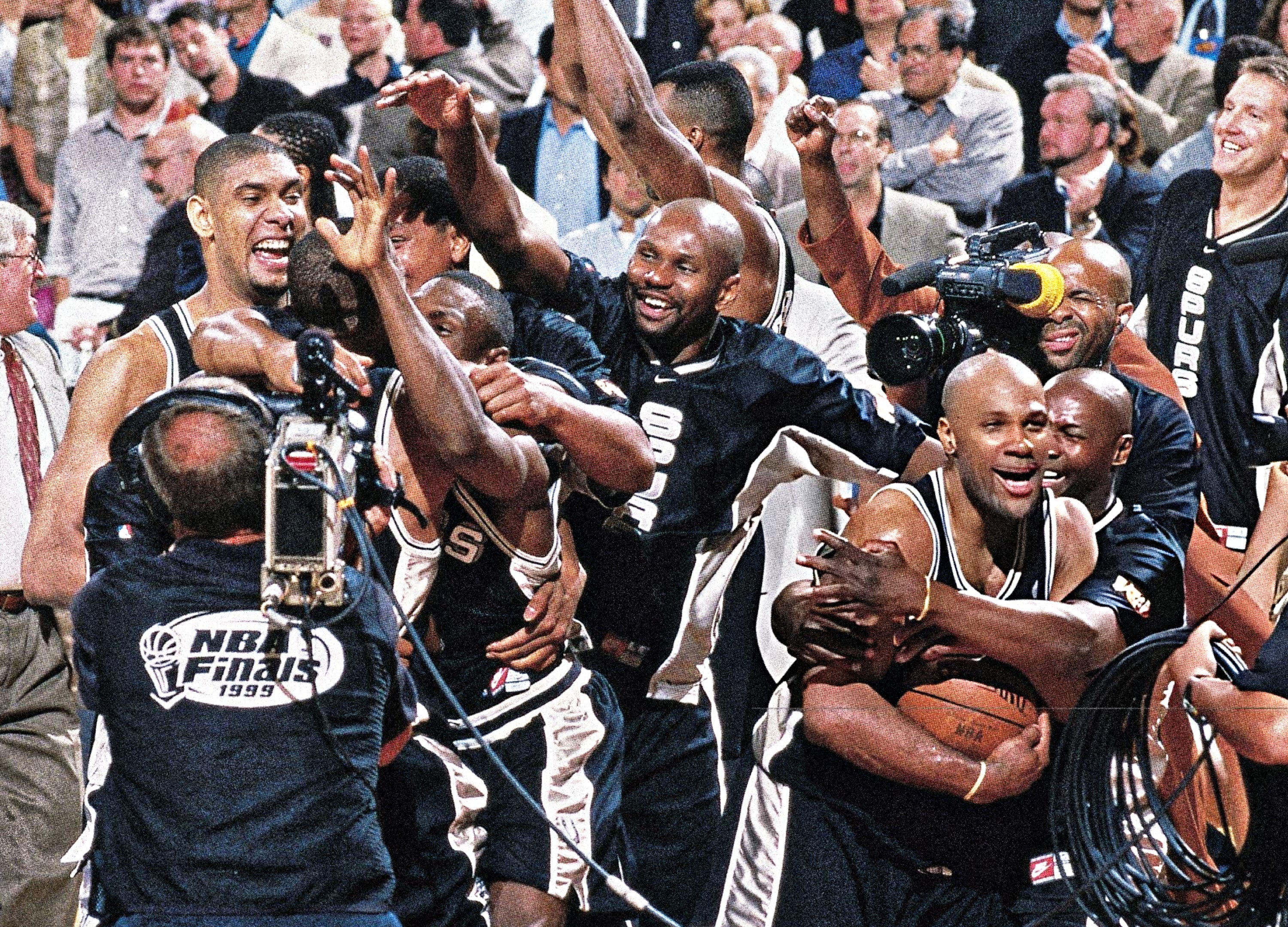
So, in the midst of the chaotic, joyous celebration at Madison Square Garden, there they are: The Admiral and his men. The image that lingers in my mind is deeply nostalgic: the music swells, the court fills with people, and David Robinson, standing tall with his son in his arms, smiles with relief and pure, unguarded delight.
One of the most nostalgic – and perhaps most joyous, capturing the spirit of the celebration – moments was captured by the Express-News in 1999:
In their locker room, however, the Spurs reveled in the cigar-smoked moment. Duncan kidded Will Perdue about drinking too much champagne. Malik Rose called his mom.
Off in a back room, Johnson and Elie leaned against a wall, talking to themselves.
“Let’s come back,” Elie said, “and do it again.”
In hindsight, we know that the San Antonio Spurs would claim another championship in 2003. This time, however, only a handful of the 1999 roster were there to celebrate. David Robinson and Tim Duncan, of course, remained loyal to the team until their respective retirements, with Robinson finishing his career in 2003 immediately after winning the title. Sean Elliott had retired in 2001, and Avery Johnson was playing for Dallas. Of the 1999 roster, only a few players – Steve Kerr and Malik Rose – remained in San Antonio, while new faces joined the team, including the future international Spurs legends, Tony Parker and Manu Ginóbili. Antonio Daniels, traded to the Portland Trail Blazers in 2002, recalls that moment, “One of my biggest regrets is not embracing that moment. I thought, ‘We got Tim. We got David. We’ll be here every year.’ I didn’t understand how difficult it was. I made it my second year in the NBA, and I never got back again.”
The journey continued, yet it’s truly astounding to think that the modern San Antonio Spurs may have begun with nothing more than the idea of David Robinson. Not Robinson himself, but the idea. The notion of him playing in San Antonio, elevating the city into a celebrated, winning community, and transforming a talented yet fragile team into genuine contenders and, ultimately, champions.
I guess that’s the Admiral to you.
Phil Jackson never would have called 1999 an asterisk year if he had won. It's such an absurd comment that I had totally forgotten about it until you mentioned it.
I loved watching David Robinson play basketball. Popovich is an asshole. San Antonio is an awesome town but the Robinson "broken foot" of 96-97 was the biggest bunch of bullshit ever pulled in the NBA. The ultimate tank job of the decade. Fucking Navy.